
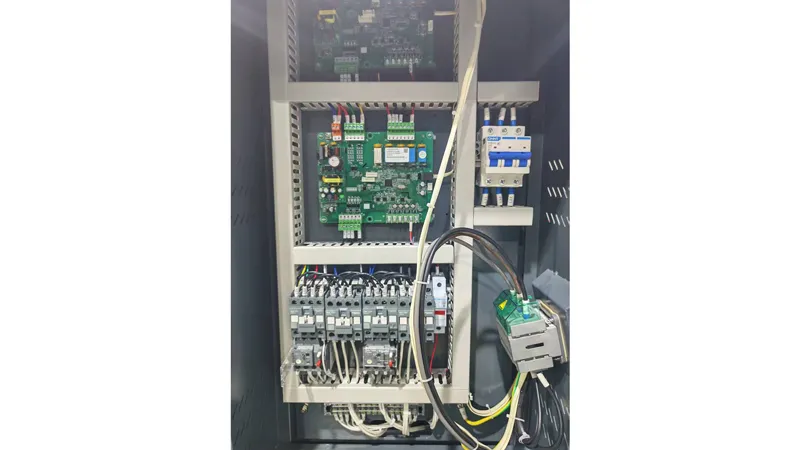
Technical Specifications
| Model | Max Temp (°C) | Heating Power (kW) | Pump Flow (L/min) | Pump Pressure (Bar) | Cooling Method |
|---|---|---|---|---|---|
| HY-600 | 200 | 6 | 27 | 3.8 | Indirect Cooling |
| HY-600-D | 200 | 6×2 | 27×2 | 3.8 | Indirect Cooling |
| HY-900 | 200 | 9 | 42 | 5.0 | Indirect Cooling |
| HY-900-D | 200 | 9×2 | 42×2 | 5.0 | Indirect Cooling |
| HY-1200 | 200 | 12 | 74 | 6.2 | Indirect Cooling |
| HY-2400 | 200 | 24 | 130 | 8.0 | Indirect Cooling |
| HY-3600 | 200 | 36 | 200 | 8.0 | Indirect Cooling |
| HY-900HT | 300 | 9 | 28 | 4.8 | Indirect Cooling |
| HY-1200HT | 300 | 12 | 58 | 5.8 | Indirect Cooling |
| HY-1200HT | 300 | 24 | 100 | 8.0 | Indirect Cooling |
Tank & Heating System
| Model | Pump Power (kW) | Heater Qty | Main / Sub Tank (L) | Mold Connection |
|---|---|---|---|---|
| HY-600 | 0.37 | 1 | 6 × 3.2 | 3/8" (2×2) |
| HY-600-D | 0.37×2 | 2 | 6 × 3.2 × 2 | 3/8" (4×2) |
| HY-900 | 0.75 | 1 | 6 × 3.2 | 3/8" (2×2) |
| HY-900-D | 0.75×2 | 2 | 6 × 3.2 × 2 | 3/8" (4×2) |
| HY-1200 | 1.5 | 1 | 6.8 × 11.8 | 3/8" (4×2) |
| HY-2400 | 3 | 2 | 11 / 16 | 1" (1×2) |
| HY-3600 | 4 | 3 | 14 / 16 | 1¼" (1×2) |
| HY-900HT | 0.75 | 1 | 6 / 6 | 3/4" |
| HY-1200HT | 1 | 1 | 6.8 / 16 | 1" |
| HY-1200HT | 2.8 | 2 | 16 / 25 | 1" |
Dimensions & Weight
| Model | Dimensions (mm) | Weight (kg) |
|---|---|---|
| HY-600 | 635 × 280 × 740 | 60 |
| HY-600-D | 655 × 510 × 740 | 100 |
| HY-900 | 655 × 280 × 740 | 72 |
| HY-900-D | 655 × 510 × 740 | 105 |
| HY-1200 | 695 × 340 × 815 | 120 |
| HY-2400 | 870 × 360 × 930 | 140 |
| HY-3600 | 980 × 415 × 930 | 165 |
| HY-900HT | 695 × 280 × 740 | 75 |
| HY-1200HT | 1000 × 400 × 800 | 90 |
| HY-1200HT | 1050 × 515 × 910 | 190 |
| Custom non-standard models are available upon request. | ||
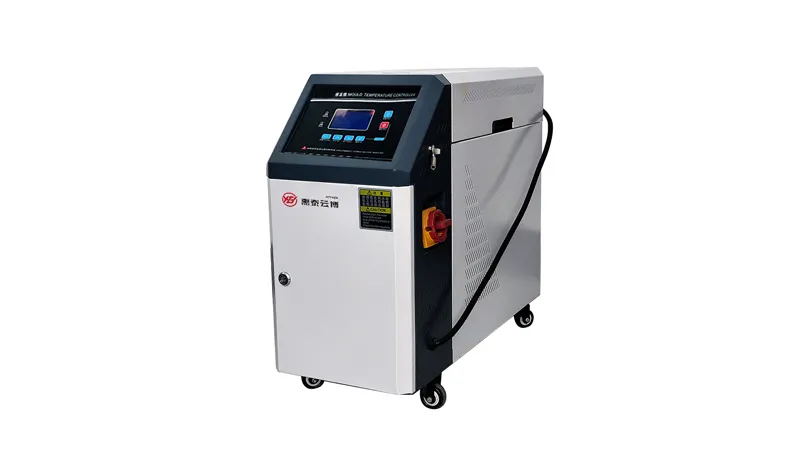
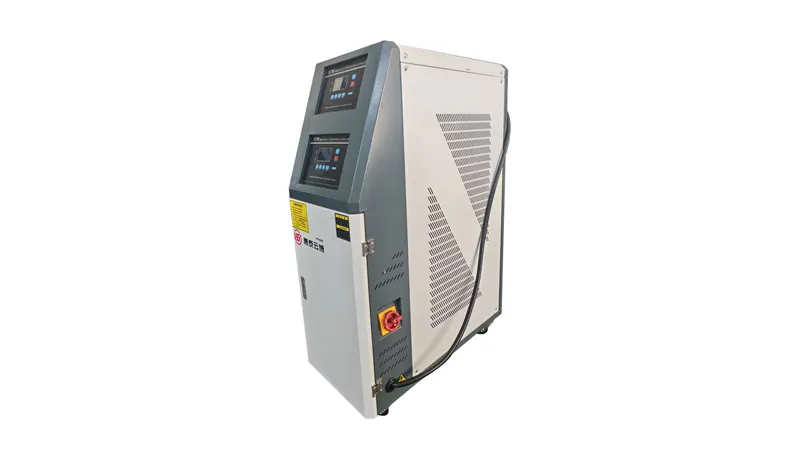
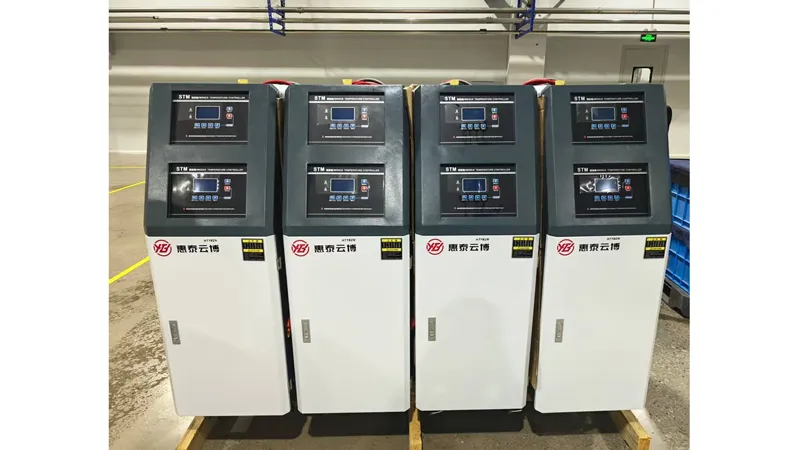
Oil Mold Temperature Controller for High Temperature Industrial Applications
The oil mold temperature controller is an essential temperature control device used in industrial molding and high-temperature processing applications. Using thermal oil as the heat transfer medium, it provides stable, uniform, and high-temperature heating for molds, reactors, extruders, and processing equipment.
Compared with water-based temperature controllers, oil systems offer a wider temperature control range, better high-temperature stability, and strong resistance to freezing, making them ideal for demanding applications such as engineering plastics, die casting, and composite material processing. :contentReference[oaicite:0]{index=0}
This system ensures consistent temperature distribution, reduces thermal stress on molds, and helps improve product quality by minimizing defects such as warping, shrinkage, and surface imperfections. It is widely used in industries including injection molding, extrusion, die casting, rubber processing, and chemical production. :contentReference[oaicite:1]{index=1}
Key Advantages
- Wide Temperature Range: Suitable for high-temperature processes beyond the limits of water systems.
- Stable Heat Transfer: Thermal oil provides uniform heating without local overheating.
- Precise Temperature Control: PID controller ensures accurate and stable temperature regulation.
- Reliable Operation: Designed with high-efficiency heaters and durable high-temperature pumps.
- Safe and Protected: Equipped with overheat protection, pressure protection, oil level protection, and leakage protection.
- Low Maintenance: Long oil replacement cycle and minimal daily maintenance requirements.
- Cold Environment Friendly: No freezing risk, suitable for low-temperature regions.
Applications of Oil Temperature Controllers
Oil temperature controllers are widely used in high-temperature industrial processes requiring stable and uniform heating.
Injection Molding
High temperature mold heating for engineering plastics such as PA, PC, and nylon.
Extrusion Industry
Temperature control for barrels and dies in pipe, sheet and film production.
Die Casting
Maintaining mold temperature for aluminum and zinc alloy casting.
Rubber & Chemical Industry
Providing stable heating for reactors and processing equipment.
Frequently Asked Questions
What is an oil mold temperature controller?
It is a temperature control system that uses thermal oil as the heat transfer medium to provide stable high-temperature heating.
What are the advantages over water temperature controllers?
Oil systems offer a wider temperature range, better high-temperature stability, and no risk of freezing.
What industries use oil temperature controllers?
It is widely used in injection molding, extrusion, die casting, rubber processing, and chemical industries.
Is maintenance complicated?
No, it requires only periodic oil level checks and occasional oil replacement, making it easy to maintain.
Can it operate in cold environments?
Yes, thermal oil does not freeze, making it suitable for low-temperature environments.