
Technical Specifications
| Model | Max Temp (°C) | Heating Power (kW) | Pump Flow (L/min) | Pump Pressure (Bar) | Cooling Method |
|---|---|---|---|---|---|
| HY-600W | 120 | 6 | 27 | 3.8 | Direct Cooling |
| HY-600W-D | 120 | 6×2 | 27×2 | 3.8 | Direct Cooling |
| HY-900W | 120 | 9 | 42 | 5.0 | Direct Cooling |
| HY-900W-D | 120 | 9×2 | 42×2 | 5.5 | Direct Cooling |
| HY-1200W | 120 | 12 | 74 | 6.2 | Direct Cooling |
| HY-2400W | 120 | 24 | 130 | 8.0 | Direct Cooling |
| HY-3600W | 120 | 36 | 200 | 8.0 | Direct Cooling |
| HY-600PW | 180 | 6 | 27 | 3.8 | Indirect Cooling |
| HY-900PW | 180 | 9 | 42 | 5.0 | Indirect Cooling |
| HY-1200PW | 180 | 12 | 74 | 6.2 | Indirect Cooling |
| Model | Pump Power (kW) | Heater Quantity | Heater Tank Capacity (L) | Mold Connection | Dimensions (mm) | Weight (kg) |
|---|---|---|---|---|---|---|
| HY-600W | 0.37 | 1 | 3 | 3/8" (2×2) | 635 × 280 × 740 | 60 |
| HY-600W-D | 0.37×2 | 2 | 3×2 | 3/8" (4×2) | 655 × 510 × 740 | 100 |
| HY-900W | 0.75 | 1 | 3 | 3/8" (4×2) | 655 × 280 × 740 | 72 |
| HY-900W-D | 0.75×2 | 2 | 3×2 | 3/8" (4×2) | 655 × 510 × 740 | 105 |
| HY-1200W | 1.5 | 2 | 6 | 3/8" (4×2) | 695 × 340 × 815 | 120 |
| HY-2400W | 2.8 | 2 | 7.4 | 1" (1×2) | 870 × 360 × 930 | 140 |
| HY-3600W | 4 | 4 | 17.4 | 1" (1×2) | 980 × 415 × 930 | 165 |
| HY-600PW | 0.55 | 1 | 3.4 | 3/8" (2×2) | 765 × 320 × 765 | 80 |
| HY-900PW | 0.75 | 1 | 3.4 | 3/8" (2×2) | 765 × 320 × 765 | 85 |
| HY-1200PW | 1.5 | 1 | 3.4 | 1" (1×2) | 795 × 340 × 820 | 95 |
| Custom non-standard models are available upon request. | ||||||
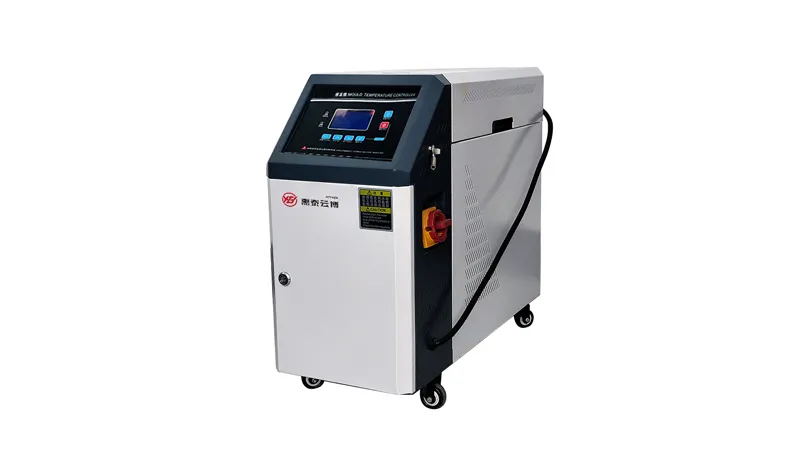
Water Mold Temperature Controller for Precise Process Heating
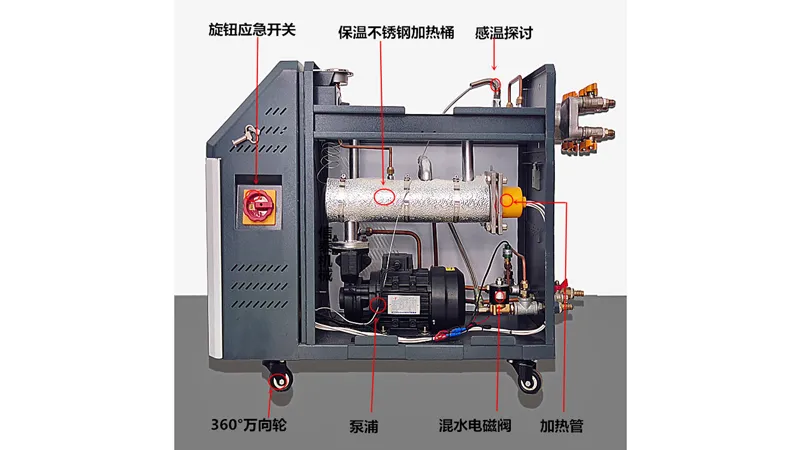
The water mold temperature controller is a core temperature control device used in industrial molding and processing applications. It uses water as the heat transfer medium to provide stable and precise temperature control for molds, reactors, and processing equipment.
Compared with oil temperature controllers, water-based systems offer higher heat transfer efficiency, faster heating and cooling response, and lower operating cost, making them ideal for applications requiring uniform temperature distribution and rapid thermal cycling. :contentReference[oaicite:0]{index=0}
The system is widely used in injection molding, extrusion, die casting, rubber processing, and chemical industries, helping improve product quality, reduce defects, and increase production efficiency. :contentReference[oaicite:1]{index=1}
Key Advantages
- Precise Temperature Control: PID intelligent controller maintains temperature stability within ±0.1°C.
- High Heat Transfer Efficiency: Water transfers heat 3–5 times more efficiently than thermal oil.
- Fast Heating & Cooling: Shortens mold preheating time and production cycle.
- Clean Operation: No oil fumes, no odor, suitable for clean production environments.
- Durable Construction: Stainless steel pipeline prevents corrosion and scaling.
- Smart Safety System: Includes low water protection, overheat protection, pressure protection and automatic shutdown.
- Flexible Configuration: Available in standard (40–120°C) and high temperature models (up to 180°C).
Applications of Water Temperature Controllers
Water mold temperature controllers are widely used in industrial processes that require stable heating and temperature control.
Injection Molding Industry
Controlling mold temperature to improve surface finish and dimensional accuracy.
Extrusion Production
Maintaining stable temperature for barrels and die heads.
Die Casting Industry
Reducing thermal stress and extending mold life.
Chemical & Rubber Processing
Providing stable heating for reactors and processing equipment.
Frequently Asked Questions
What is a water mold temperature controller?
It is a temperature control device that uses water to regulate mold temperature in industrial production processes.
What are the advantages over oil temperature controllers?
Water systems offer higher heat transfer efficiency, faster response, cleaner operation, and lower operating costs.
What industries use this equipment?
It is widely used in injection molding, extrusion, die casting, rubber processing, and chemical industries.
What is the temperature range?
Standard models operate from 40°C to 120°C, while high-temperature models can reach up to 180°C.
Does it require special maintenance?
No, it is easy to maintain. Water can be directly added or replaced, and key components are accessible for servicing.